Free AI buyer workflow
Find potential buyers, check public sources and draft questions with SYSTEM.
Start the workflowCopyable prompts + agent project THE FIRST
Two free resources from Ali Lari to help you research buyers and question the assumptions behind your idea.
Free to access. No email signup. No purchase.
Find potential buyers, check public sources and draft questions with SYSTEM.
Start the workflowCopyable prompts + agent projectReview your last attempt and separate facts from assumptions in Module 1.
Open Module 1 PDFNobody Wanted It · Opens the free PDF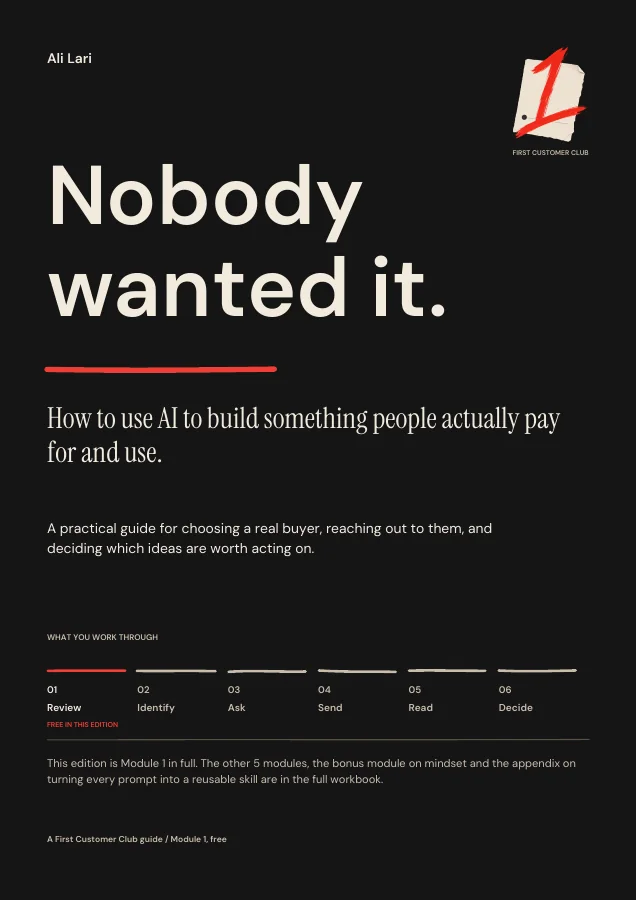
You built something, put it out there, or tried to sell it. Before changing the idea again, look at what happened.
Open free Module 1Opens the free PDF. Read it independently of the workflow.
The first module of Nobody Wanted It walks you through that review. Bring an attempt you can examine honestly.
Start with a specific buyer and a problem you suspect they face. The AI finds public pages and checks its own candidate list against them. You do not need to gather sources first.
Requires a browsing-enabled AI. Model or tool access may have costs or limits. A candidate list does not prove demand.
Tell the AI who you want to learn from and what problem you suspect they might face. Add a location or market if it matters. The AI does the public source search.
Use a chat or coding agent that can browse and open web pages. Keep private customer notes, contact lists, credentials and confidential work out of the prompt.
“Independent brand designers who manage client feedback on small projects.”
Use a browsing-enabled Claude, ChatGPT or another LLM. Search results alone are not checked sources.
I want to find potential buyers, not prove demand.

Buyer: [specific role or business]
Suspected problem: [one sentence]
Market or location: [optional]

Search the public web for relevant businesses or people. Open each promising public page and read the relevant text. Search snippets alone do not count. Use only pages you actually opened. If you cannot browse or a page is blocked, say so; do not invent a source.

Give me up to 10 candidates. For each, include:
1. Name and the public page URL you opened.
2. A short exact quote or observable fact supporting the buyer fit.
3. What the page confirms and when you checked it.
4. Why my suspected problem might be relevant, labelled as an inference.
5. One respectful question about a recent real instance.

Check every row against its opened page before presenting it. Remove broken, stale, ambiguous or unsupported rows. Return fewer than 10 if evidence is weak. Do not invent contact details, budgets, need, buying intent or contact permission. A public page cannot prove the problem exists.
The AI opens each public page, checks the evidence and drops rows it cannot support. In the downloadable project, a local validator also rejects quotes missing from captured page text.
You can use the candidate list directly as a research starting point. A checked page shows a public observation; it does not establish that the buyer has the suspected problem or wants an offer.
This prompt prepares notes. It does not send outreach.
Using only the source-checked candidates above, draft one short research note per candidate. Mention the public observation, ask about a recent instance of the suspected problem and make it easy to decline. Do not pretend we have met or claim they need my offer. Keep the source URL alongside each note. Do not send anything.
The AI can check the public rows. A real conversation, commitment or observed behaviour is what tests the idea. No messages are sent by this workflow.
After you open a source and confirm what it supports, you can mark that step here. Keep your research in your own notes.
The free resources stand on their own. The full Nobody Wanted It workbook is available separately for $9, paid once.
See what the full workbook includesPrefer to talk through your situation? See 1:1 coaching details.